Dry Needling With E-Stim: The Physiological Effects and How It Can Help Reduce Pain

Muscle tightness, stubborn aches, and movement restrictions can sometimes be difficult to resolve with stretching and exercise alone. At Behm Muscle & Joint Clinic in Bellevue, NE, dry needling with electrical stimulation (e-stim) is one of the treatment options we use to address certain muscular and movement-related problems.
But what actually happens in the body when a needle is inserted into a muscle—and why can adding electrical stimulation make the treatment even more effective?
Understanding the physiology behind dry needling can help explain why this technique can have both a local mechanical effect and an analgesic effect on pain.
What Is Dry Needling?
Dry needling is a treatment technique that uses thin, sterile needles to target specific muscles and soft tissues.
At Behm Muscle & Joint Clinic, dry needling is used as part of a musculoskeletal treatment approach. Needles may be directed toward areas of increased muscle tension, trigger points, or other tissues identified during the examination.

The goal isn't simply to "poke a tight muscle." The needle provides a very specific stimulus to the nervous system and the tissues being treated.
What Happens Physiologically When a Muscle Is Needled?
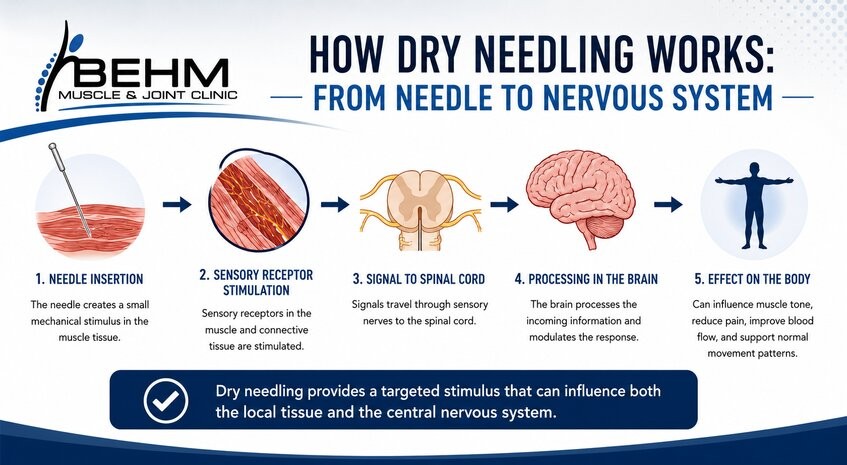
When a needle enters muscle tissue, several physiological responses can occur.
1. A Local Mechanical Stimulus
- The needle creates a small mechanical stimulus within the tissue. This can affect muscle fibers, connective tissue, and sensory receptors.
- When a needle is placed into a taut band of muscle, it can sometimes produce a local twitch response—a brief, involuntary contraction of the muscle.
- This response is different from simply stretching the muscle. It provides a specific neurological and mechanical stimulus to the involved tissue.
2. Changes in Muscle Tone
- Needling may influence the activity of the muscle and its motor endplates.
- When a muscle remains in a heightened state of activity, it can contribute to pain, stiffness, and restricted movement. Stimulating the tissue may help reduce excessive muscle activity and allow the muscle to return toward a more normal resting state.
- This can potentially improve the muscle's ability to lengthen and contract appropriately.
3. Increased Local Blood Flow
- Needling can also influence local circulation.
- Research has demonstrated changes in local blood flow following dry needling, particularly around treated areas. Increased circulation may help alter the local chemical environment of tissues and support the body's normal recovery processes.
- This is one reason patients may notice a feeling of warmth or relaxation in the treated area.
4. Afferent Nervous System Stimulation
- One of the most important effects of dry needling may occur through the nervous system.
- The needle stimulates sensory nerve fibers within the tissue. These signals travel through the peripheral nervous system and communicate with the spinal cord and brain.
- This sensory input can influence how the nervous system processes pain and other sensory information.
How Can Dry Needling Have an Analgesic Effect?
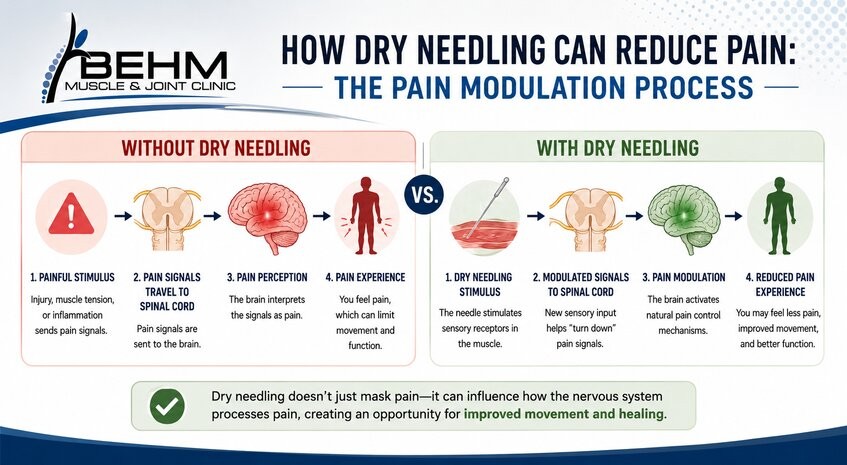
One of the reasons dry needling is used clinically is its potential to produce an analgesic, or pain-relieving, effect.
Pain isn't simply a signal coming from an injured muscle. It is an experience produced by the nervous system based on information coming from the body and how that information is processed.
Dry needling provides a strong, controlled sensory input that can influence this process.
Spinal-Level Pain Modulation
Sensory information from the needle travels into the spinal cord. This input can activate mechanisms that help modulate incoming pain signals.
In simple terms, the nervous system receives a new sensory signal that can interfere with or reduce the transmission of some pain-related information.
This is one explanation for why some patients experience a decrease in pain during or shortly after treatment.
Descending Pain Modulation
Dry needling may also influence higher-level pain-modulating systems within the brain and nervous system.
The body has its own built-in pain-control mechanisms. These systems can release endogenous pain-relieving chemicals and alter how strongly pain signals are perceived.
This is sometimes referred to as descending pain modulation.
The result isn't necessarily that the underlying problem has immediately disappeared. Instead, the nervous system's response to the painful stimulus may be temporarily reduced, giving the patient an opportunity to move and exercise with less discomfort.
Local Chemical Effects
Trigger points and painful muscles can demonstrate changes in the local chemical environment, including substances associated with pain and inflammation.
Needling may influence this local biochemical environment and reduce the concentration of certain pain-related substances.
This is another potential mechanism contributing to the analgesic effects of dry needling.
What Happens When We Add E-Stim to Dry Needling?
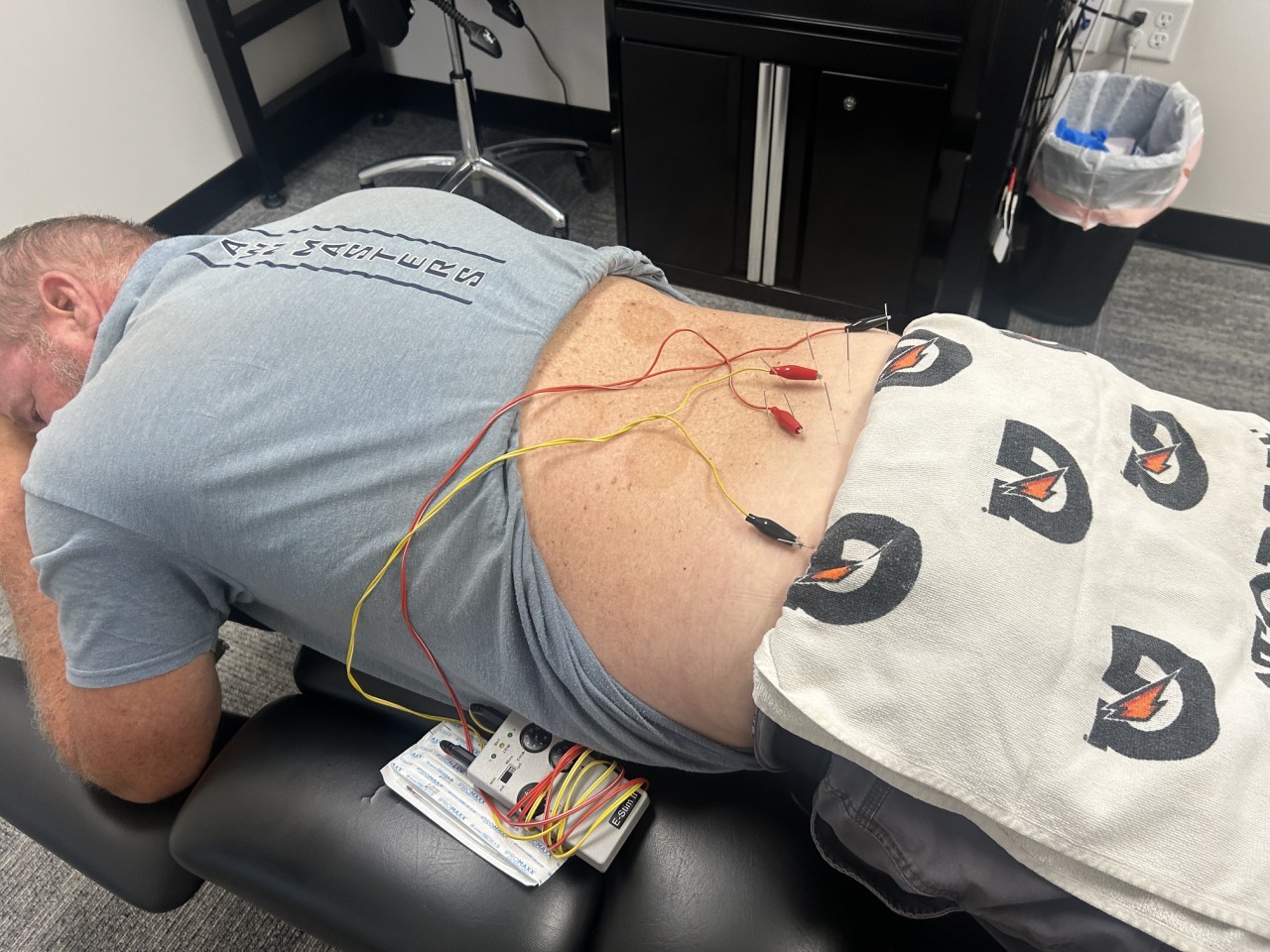
Electrical stimulation can take the treatment one step further. Instead of the needle providing a brief mechanical and sensory stimulus, e-stim can provide repeated, controlled stimulation over a period of time. During dry needling with e-stim, small electrical impulses are delivered through the needles placed in the targeted muscles. Depending on the settings and treatment goal, the muscle may gently contract or the patient may feel a rhythmic pulsing sensation.
Why Combine Dry Needling and E-Stim?
The combination of dry needling and e-stim can provide several potential advantages:
Repeated Muscle Stimulation
With traditional dry needling, the mechanical stimulus comes primarily from the needle placement and manipulation. With e-stim, the electrical current can repeatedly stimulate the targeted tissue. This may produce rhythmic muscle contractions that can help influence muscle tone and provide additional sensory input to the nervous system.
Increased Sensory Input
E-stim provides a continuous or repeated sensory stimulus rather than a single needle stimulus. This additional input may further activate sensory pathways involved in pain modulation.
Potentially Greater Analgesic Effect
Electrical stimulation has its own analgesic mechanisms. Depending on the parameters used, e-stim may stimulate sensory nerve fibers and activate pain-inhibitory pathways. When combined with dry needling, the clinician can target a specific muscle or region while simultaneously providing controlled electrical stimulation. The goal is not simply to create a stronger sensation. It is to use the appropriate type and intensity of stimulation for the patient's condition and treatment goals.
Dry Needling vs. Dry Needling With E-Stim
Think of the difference this way:
- Dry needling:
The needle provides a localized mechanical and sensory stimulus to the tissue. - Dry needling + e-stim:
The needle provides the localized stimulus while electrical stimulation adds repeated sensory and/or motor stimulation to the targeted area.
Both approaches can be useful. The decision to use e-stim depends on the patient's presentation, treatment goals, and clinical findings.
Why Pain Relief Can Be Important for Rehabilitation
Pain reduction isn't necessarily the end goal of treatment. Sometimes it's the first step that allows rehabilitation to be more effective.
For example, if a patient has significant muscle pain that prevents them from performing an exercise correctly, reducing their symptoms may allow them to move through a greater range of motion or perform strengthening exercises with better mechanics. This creates an opportunity to address the underlying movement problem. That's why dry needling with e-stim at Behm Muscle & Joint Clinic is typically used as part of a broader treatment plan rather than as a stand-alone treatment.
Treatment may also include:
- Chiropractic adjustments
- Active Release Technique (ART)
- Graston Technique
- Mobility exercises
- Strengthening
- Movement retraining
- Rehabilitation exercises
- McKenzie-based exercises
- Sport-specific rehabilitation
What Does Dry Needling With E-Stim Feel Like?
Most patients describe e-stim as a mild pulsing, tapping, or rhythmic sensation. You may notice the treated muscle gently contracting. The intensity can be adjusted throughout treatment, and the goal is to provide an effective stimulus without making the treatment unnecessarily uncomfortable. Some patients experience temporary soreness afterward, similar to what can occur following exercise.

Dry Needling With E-Stim in Bellevue, NE
If you're looking for dry needling in Bellevue, NE, Behm Muscle & Joint Clinic offers dry needling with e-stim as part of a comprehensive approach to musculoskeletal care. Whether you're dealing with persistent muscle tightness, sports-related pain, or a movement restriction that's keeping you from doing what you enjoy, our goal is simple:
Move Better. Feel Better. Live Better.
Contact Behm Muscle & Joint Clinic in Bellevue, NE to schedule an evaluation and determine whether dry needling with e-stim may be an appropriate part of your treatment plan.